Professional Practice
'Emma has demonstrated analytical thinking and when coached in supervision, was able to think about the reasons why a patient presents the way they do... and able to make a plan about the next steps in the patient's journey, and the plan for the OT to take.'
Educator
'Emma has practiced in a safe manner, adhering to professional guidance within the workplace. She is beginning to develop therapeutic rapport with service users and staff.'
Educator A
'Emma has been able to communicate with patients and established a therapeutic relationship with patients, and professional relationship with colleagues.'
Educator
Throughout my training, I have progressed within the ‘Professional Practice Pillar’ of the RCOT Career Development Framework from working under supervision to demonstrate increasing autonomy and accountability. I have developed skills in assessment, clinical reasoning and communication and now contribute more independently to discharge planning and risk assessment, reflecting my readiness for safe and effective practice.
This aligns with HCPC and RCOT standards by outlining the knowledge, skills and behaviours required to deliver competent, holistic and personalised care whilst supporting ongoing professional development.
SWOT Analysis
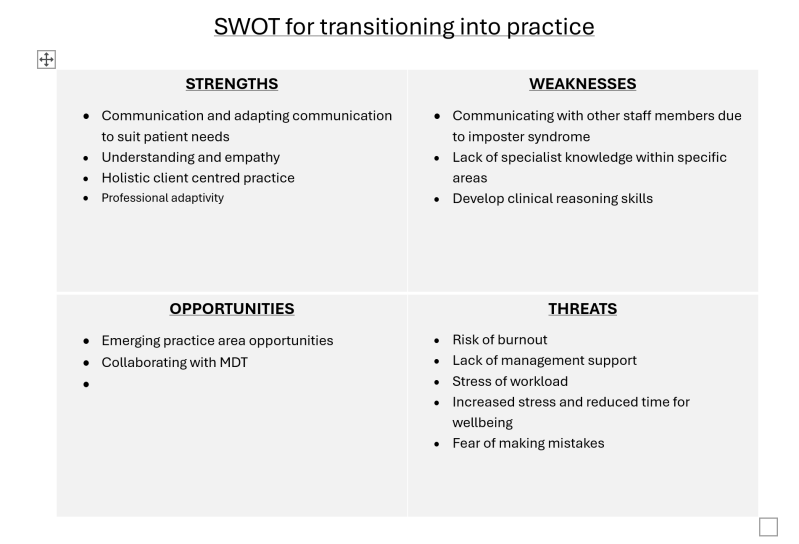
This SWOT analysis highlights my current level of competence and identifies key areas for development as I transition into practice. It supports my commitment to ongoing professional development and safe, personalised care.
This meets HCPC and RCOT guidelines by:
- Maintaining fitness to practice
- Professional judgement and accountability
- Reflective practice
- Professional development
Case study Presentation
This case study demonstrates my competence within the ‘Professional Practice Pillar’ of RCOT CDF through the application of assessment, clinical reasoning, intervention planning and risk management whilst aligning with HCPC standards of proficiency and RCOT guidelines. This ensures practice is evidence-based, ethically informed and responsive to the individual’s needs, providing high quality care.
This meets HCPC and RCOT guidelines by:
- Safe and effective practice
- Clinical reasoning and decision making
- Assessment and intervention
- Communication and MDT working
- Person-centred practice
- Evidence-based practice
Mandatory Training
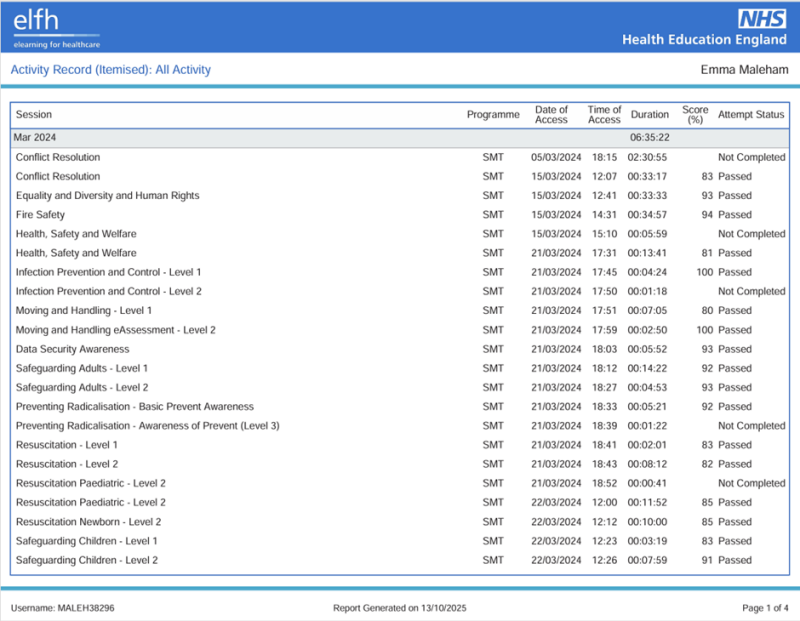
Completion of mandatory training supports the Professional Practice pillar by enhancing my understanding of risk management, policies, and professional responsibilities, enabling me to practice safely, effectively, and in line with HCPC and RCOT standards
Completion of mandatory training is vital as it underpins safe, legal, and ethical practice, ensuring I am equipped to manage risk and deliver high-quality care in line with professional standards.
HCPC Standards this aligns with:
- Safe and effective practice
- Maintaining fitness to practice
- Managing risk
- Professional responsibility and accountability
- Confidentiality and safeguarding
SOAP note sentence starters and SOAP documentation
The use of a SOAP note template demonstrates my ability to apply structured clinical reasoning, document decisions clearly and plan appropriate interventions, supporting continuity of care, professional accountability and safe practice.
This SOAP note shows my development within the Professional Practice pillar by demonstrating my ability to carry out a thorough assessment, interpret key information, and plan appropriate, person-centred interventions. It also reflects my growing confidence in clinical reasoning and documenting decisions clearly, supporting safe and effective care in line with professional standards.
OT process within setting
Including the above OT process meets the professional practice pillar competence below:
P8.6 Role-model how to complete the occupational therapy process using independent decision making skills within complex and unpredictable contexts
Utilising the occupational therapy process within practice demonstrates my ability to work in a structured and clinically reasoned way, supporting safe, person-centred assessment, intervention, and evaluation, and reflecting competence within the Professional Practice pillar in line with HCPC and RCOT standards.
Care Plans and clinical reasoning
Inclusion of care plans alongside clinical reasoning demonstrates my ability to apply insight from assessments to develop and utilise into clear, practical decisions that support the patient. It reflects my ability to evaluate situations, justify my choices, and plan safe, person-centred interventions, which are all key to developing as a competent practitioner.
MDT Working Reflection
Reflecting on MDT working and discussions with other professionals demonstrates my development within the Professional Practice pillar by highlighting my ability to communicate effectively, collaborate within a team and contribute to shared decision-making. Through these interactions, I have developed my clinical reasoning by considering different professional perspectives and applying them to patient care. Reflecting on these experiences also supports my CPD, as it enables identification of areas for improvement, building confidence in professional discussions, and enhancing my ability to deliver safe, coordinated and person-centred care.